


There’s a quiet but meaningful shift underway in insurance.
For decades, the model has always been to assess risk, price it, and pay out when something goes wrong. But as climate volatility increases, bringing more intense and less predictable weather, this approach is starting to show its limits.
Into that gap steps Previsico, operating at the intersection of scientific modelling and real-world decision-making.
Why this matters now
Flood risk is no longer a peripheral climate concern. It is fast becoming one of the most underestimated balance-sheet threats facing businesses and insurers globally. Over the last five years alone, flooding has caused an estimated $325bn in economic losses worldwide, yet only $70bn was insured(source Munich Re), exposing a widening protection gap that the industry can no longer ignore.
Climate patterns are becoming more volatile, with intense rainfall events and sudden weather changes challenging models built on historical data.
The scale of the challenge is stark. In the UK alone, surface-water flood risk could impact 6.1 million properties by 2050 – a 30% increase (source NaFRA) compared to previous projections. In the US, flooding has not only greatly increased, it has accelerated and changed to create even greater losses to property and infrastructure over the past decade, driven by heavier rainfall, and more volatile weather patterns.
At the same time, in other parts of the world, flood risk remains underinsured or poorly understood. Better data that enables flood mitigation opens doors to more properties being covered, including those that were previously deemed high risk or uninsurable via more informed decision-making.
The blind spot in flood risk
Flooding isn’t new. But the industry’s understanding of it has been incomplete.
Traditional models have focused primarily on river and coastal flooding that are generally slower, more predictable, and geographically contained. The bigger challenge lies elsewhere.
Surface water flooding, which accounts for a significant proportion of flood events, behaves very differently. It occurs when intense rainfall overwhelms drainage systems, and its impact depends on highly variable factors like soil saturation, terrain, and real-time weather conditions. It can develop within hours, often with little warning, and its effects are highly localised.
This makes it difficult to model using conventional approaches. Many insurance frameworks were never designed to handle risk that is this dynamic and fast-moving.
A real-time view of risk
Previsico’s origins are not in insurance, but in academic research; specifically, surface water flood modelling led by Dapeng Yu at Loughborough University.
What emerged was a platform that shifts the perspective from historical analysis to live forecasting.
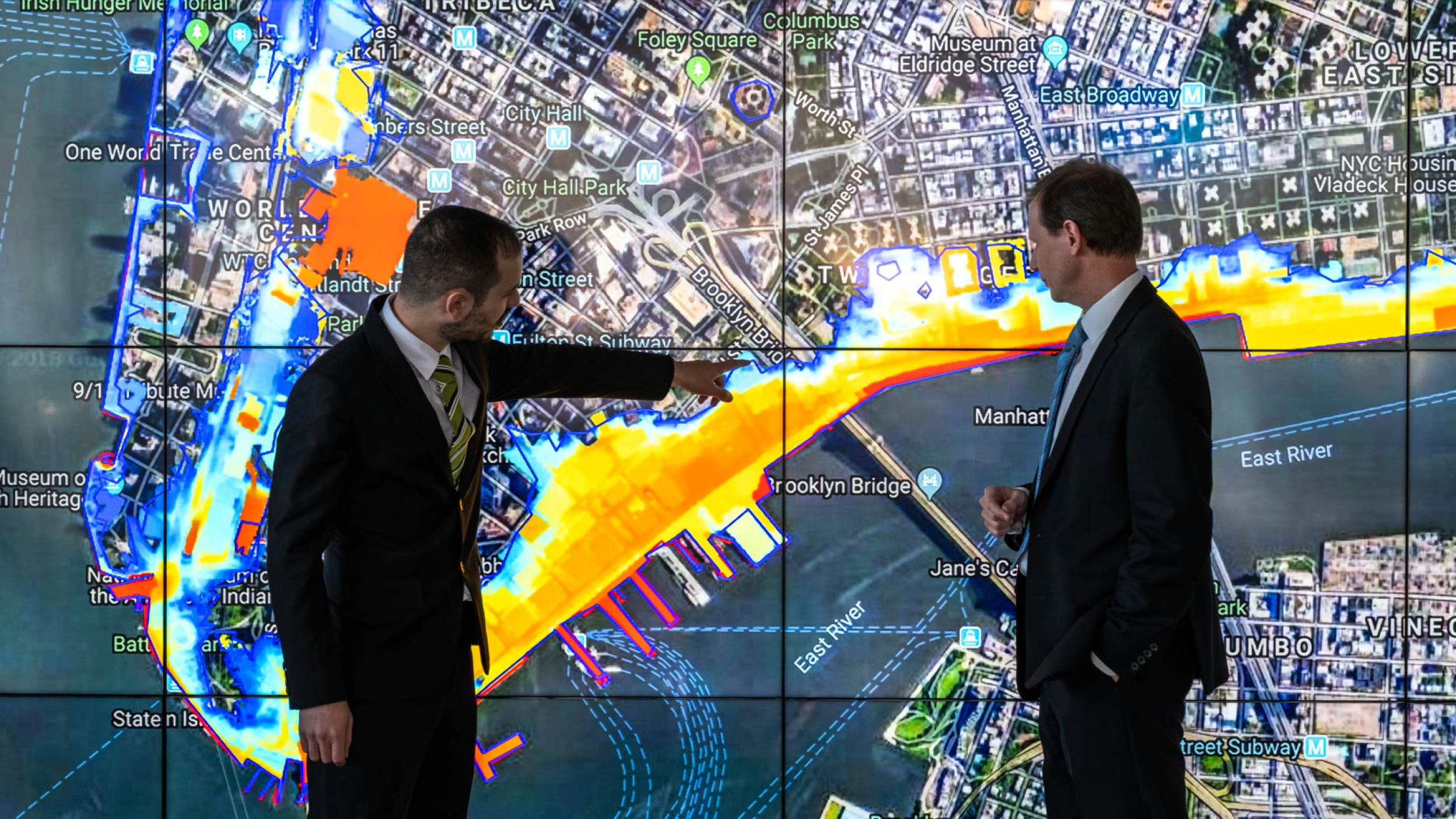
Rather than relying on static risk scores, Previsico generates continuously updated forecasts, predicting flood risk up to 48 hours in advance at the level of individual properties. These forecasts evolve in real time, incorporating changing weather patterns and environmental conditions.
At its core, the system combines hyper-local weather data, terrain and drainage modelling, and ground condition monitoring. In some deployments, it is also supported by IoT sensors that track water levels and flow rates in streams and culverts, adding another layer of real-world validation.
The result is not a snapshot of risk, but a live picture of what is likely to happen next.
Turning insight into action
What makes this approach particularly valuable is how it translates into action.
At the operational level, the impact is immediate. A business might receive an alert indicating significant flooding risk within the next day. That early warning enables practical steps, such as moving assets, deploying temporary defences, or adjusting operations, before disruption occurs.
For example, Previsico’s customer, Balfour Beatty Vinci’s HS2, illustrated this shift in practice.
After suffering multi-million-pound flood losses, the company used Previsico’s predictive flood intelligence and sensors to protect sites, relocate critical equipment, and avoid repeat losses when the next event occurred provide.
For insurers, this changes the dynamic. Losses can be reduced not just through pricing and coverage decisions, but by helping clients act earlier and more effectively. The relationship moves closer to risk partnership rather than pure risk transfer.
A smarter approach to underwriting
The same data also reshapes how risk is evaluated upstream.
Instead of broad assumptions about whether an area is flood-prone, insurers can begin to understand the specific conditions under which a location is likely to flood, and how frequently those conditions arise.
This enables more precise pricing, better segmentation of risk portfolios, and the potential to link coverage more closely to proactive risk management. Underwriting becomes less about static categories and more about dynamic behaviour.
From yes or no to probability
A key evolution in Previsico’s approach is the move toward probabilistic forecasting.
Rather than making binary predictions (will it flood or not), the platform expresses risk in terms of likelihood and severity, for example, indicating a percentage probability of significant flooding within a given timeframe.
This shift matters, as it greatly improves decision-making on the ground. Too many false alarms can lead to inaction; too little warning leads to losses.
Probabilistic insight helps strike a more effective balance, enabling calibrated actionable insights.
Looking ahead
Seen in a wider context, Previsico represents more than a technical innovation. It reflects a broader direction of travel for the insurance industry.
Risk assessment is becoming continuous rather than periodic. Monitoring replaces static evaluation. Prevention becomes embedded in operations rather than treated as an afterthought.
The same underlying technology can also serve multiple purposes, protecting commercial assets while supporting resilience in more vulnerable communities.
Final thought
Insurance has always been about managing uncertainty. What’s changing is the timeframe.
The focus is shifting from long-term projections, what might happen over the next year, to short-term foresight: what is likely to happen in the next 48 hours, and what can be done about it.
Previsico sits squarely in that shift.
And if this model continues to scale, the future of insurance may be defined less by how efficiently it responds to loss, and more by how effectively it helps prevent it.